Ankle Mobility for Better Squats: The Connection to Your Knee Pain
Tight ankles might be the real reason your knee hurts when squatting. Learn how ankle mobility directly affects your knee and what to do about it.
Here's something most people never consider when their knee starts hurting:
Your ankle stiffness might be the culprit.
I know. Your ankle feels fine. You're not having ankle pain. So how could your ankle have anything to do with knee pain?
This is where the body's interconnectedness (is that even a word?!) catches most people off guard.
When your ankle can't move the way it's supposed to move, your body has to compensate. And that compensation happens at your knee. Over weeks and months, that compensation becomes your pain.
Let me show you how this works and more importantly, how to fix it.
HOW YOUR ANKLE CONTROLS YOUR SQUAT (Even Though You Probably Didn't Know)
Close your eyes and imagine squatting down slowly.
Your knee bends. Your hip bends. Your ankle...also bends. It's bending forward (dorsiflexion, if you want the fancy word). It's a small movement but it's essential.
Here's why: As you descend into a squat, your shin needs to angle forward slightly. That forward angle comes from your ankle bending. If your ankle is stiff and can't bend forward enough, your body compensates by doing something else:
It shifts your weight backward. Your torso leans forward more. Your weight shifts to your heels. Your knee doesn't track properly over your toes. Your quad doesn't engage the way it should.
All of this happens because your ankle couldn't do its job.
Think about water flowing down a hallway. If the first doorway is too narrow (your ankle is too stiff), the water has to find another route. It spills and spreads in ways it wasn't supposed to. Your knee, downstream in a sense from your ankle, gets hit with all that rerouted stress.
THE OLD ANKLE SPRAIN THAT'S STILL HAUNTING YOU
Here's a pattern I see constantly:
Someone comes in with knee pain. We talk about their history. Five, ten, fifteen years ago? They twisted their ankle. Maybe it was a bad sprain. Maybe it was just a minor roll they didn't think much about.
It seemed fine. It healed. They moved on.
But here's what actually happened: That ankle sprain created scar tissue. It affected how the small bones in their ankle move. It changed their ankle's range of motion, usually just enough that they don't notice it in everyday life, but just enough that it causes problems when they squat or do higher-demand movements.
And now, a decade later, that old ankle sprain is causing knee pain.
This is more common than you'd think. In fact, I'd estimate that 30% of the knee pain I see in people over 40 has some contribution from old ankle issues that were never properly addressed.
The good news? Ankle mobility improves relatively quickly. Unlike structural issues, ankle stiffness responds well to consistent mobility work. You can see noticeable improvements in 3-4 weeks.
HOW TO KNOW IF YOUR ANKLE IS THE CULPRIT
Let's figure out if ankle stiffness is contributing to your knee pain.
Can you squat and keep your weight centered? Or does it feel like you're tilting backward? If you're tilting back, your ankle might not have enough forward bending capability.
Can you get into a deep squat without your heels lifting off the ground? If your heels want to come up as you squat deeper, that's a classic sign of ankle stiffness. Your ankle can't dorsiflex (bend forward) enough, so your body compensates by lifting your heel.
When you stand with your feet flat, can you lift your toes up? Try it right now. If you can't lift your toes while keeping your heel on the ground, your ankle is restricted.
Do you get calf tightness or soreness easily? Your calf muscles work overtime when your ankle is stiff. Tight calves often mean your ankle isn't moving properly.
If any of these sound like you, ankle mobility work is going to help your knee pain.
THE PHYSIOLOGY: WHAT'S ACTUALLY HAPPENING IN YOUR ANKLE
Your ankle is more complex than most people realize. It's not just one hinge. It's multiple small bones connected by ligaments and muscles. When one of these elements is restricted, whether from an old injury, scar tissue, or just years of tight calf muscles...the whole system gets stiff.
When your ankle is stiff, your body can't achieve dorsiflexion (the forward bending of your ankle). So when you squat, your tibia (shin bone) can't move the way it should. This changes how your femur (thighbone) and tibia relate to each other. Your knee bears the cost.
It's kind of like having a car where one wheel is slightly misaligned. The car still drives. It still functions. But over time, that misalignment wears on the other parts. Your knee is the part wearing.
The solution is creating mobility in that first element, your ankle, so the whole system can work the way it's designed to.
START HERE: THE SITTING CALF STRETCH
If you have knee pain and ankle stiffness, we start simple.
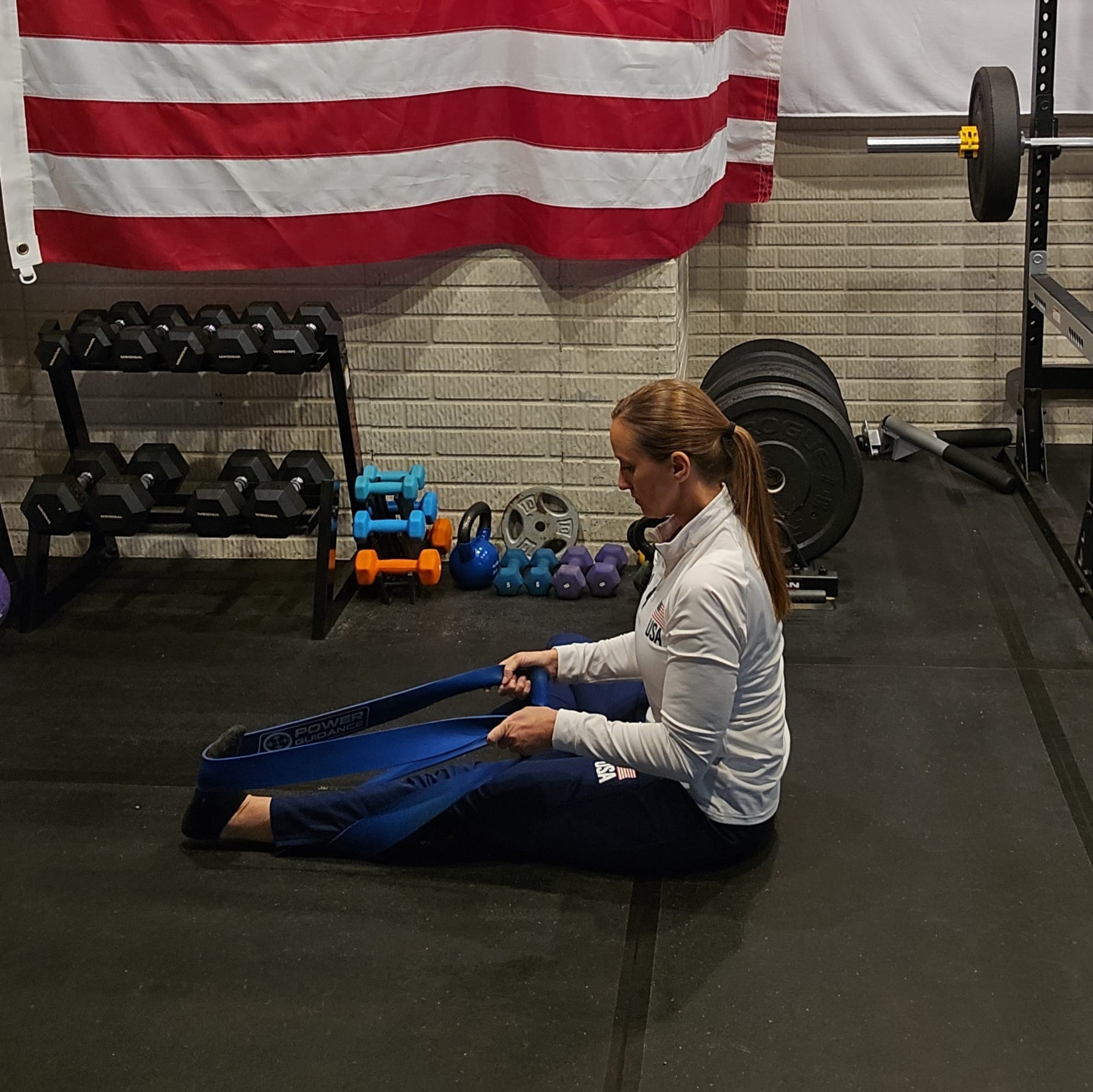
Sitting calf stretch demonstration Ankle mobility foundation: The sitting calf stretch
Sit on the floor with your legs extended. Put a resistance band (or towel) around the ball of your foot. Gently pull your toes toward your shin. You should feel a stretch in your calf muscle.
Hold this stretch for 30-45 seconds. Do it 2-3 times on each leg.
Do this daily. Morning and evening is ideal, but even once a day is better than nothing.
Here's the thing about this stretch: It might feel tight. You might feel like you're hitting a wall at a certain point. That's okay. You're not trying to force deeper. You're just trying to create space and tell your ankle it's safe to move.
Consistency matters here way more than depth. A light stretch done daily for 4 weeks will give you better results than an aggressive stretch done once or twice a week.
BUILD FROM HERE: THE ANKLE DORSIFLEXION MOBILIZATION
After 2-3 weeks of daily calf stretches, your ankle is ready for a different type of work.
 Skiv (c) 2026
Ankle dorsiflexion mobilization demonstration Creating ankle control: Seated ankle dorsiflexion
Sit with one leg extended. Place your hands on your thigh, just above the knee. Now, keeping your thigh still, point your toes away from you as far as you can (plantarflexion), then pull your toes toward your shin (dorsiflexion). Do this movement slowly and controlled, 15-20 times.
Then, do the same movement but with the back of your leg against a table or chair to add a bit more challenge.
Do this 3-4 times per week. This works both the front and back of your shin, and helps your ankle develop better mobility and control.
The key is moving slowly and feeling the muscles work. This isn't a stretch; it's active mobility. You're teaching your ankle to move through a better range with strength.
WHY THESE TWO STRATEGIES (And What You're Actually Fixing)
You might notice these aren't fancy exercises. There's no heavy weight. There's no intense workout.
But here's what's happening: You're retraining your ankle's range of motion. You're creating flexibility in your calf muscle. You're rebuilding the communication between your ankle and your nervous system about what's a safe range of motion.
Your ankle has been stiff for maybe years. You can't fix that in a week with one intense session. You fix it by consistently working the tissue, giving your nervous system permission to let go of the stiffness.
The calf stretch is passive so your body learns to relax. The ankle dorsiflexion work is active so your body learns to control the new range.
Both are essential.
My premium programs go much deeper into ankle mechanics and progressively builds your ankle strength and mobility over weeks. These two exercises are your introduction. They're your foundation. They're what you need to start experiencing the connection between ankle and knee.
CONNECTING BACK TO YOUR KNEE
Here's the remarkable thing: Most people who address their ankle mobility notice their knee pain improves without doing any specific knee work.
They do calf stretches and ankle mobility drills for 3 weeks. Then one day they squat and think, "Wait...that didn't hurt."
The pain didn't go away because they did something for their knee. It went away because they fixed the problem at the source, their ankle.
This is why it's so important to understand your cheat patterns. If your knee pain is coming from ankle stiffness, no amount of quad exercises or knee-focused work will solve it long-term. You'd be treating the symptom, not the cause.
That's why in our complete guide to knee self testing, we walk you through identifying which cheat patterns are actually affecting you. Ankle stiffness is one of them. But you might have hip weakness too. Or a tibia rotation issue. Or all of the above.
Figuring out which one (or ones) are yours is the key to actually fixing your pain.
WHAT CHANGES AS YOU BUILD ANKLE MOBILITY
Week 1: The stretch feels tight. You might feel a bit sore the day after starting (good sore as you're working tissue that hasn't been mobile).
Week 2: The stretch feels a bit easier. The range of motion is noticeably better. Your calf feels less constantly tight.
Week 3: You notice when you squat, you can keep your weight more centered. Your heels aren't trying to lift. Your torso doesn't have to lean as far forward.
Week 4: The ankle dorsiflexion movement feels smooth and controlled. When you squat, you feel more stable. Your knee pain is noticeably better.
These timelines vary depending on how stiff your ankle was to begin with, but this is the typical progression.
THE OVERLOOKED CONNECTION
Most people don't connect their ankle to their knee. They don't realize that an old sprain or just years of tight calves can be the root cause of current knee pain.
Your doctor probably didn't mention it. Your physical therapist might have. But if no one pointed it out, you'd never know.
This is where the gap exists: Between general fitness advice and actually understanding your body's interconnected systems.
Your ankle affects your knee. Your knee affects your hip. Your hip affects your lower back. Fix one issue without understanding how it affects the others, and you'll keep chasing your pain.
YOUR NEXT STEP
You now understand the ankle-knee connection. You have two strategies to improve your ankle mobility.
Here's what's next: Understanding which of your specific problems needs addressing. Is it your ankle? Your hip? Your weight distribution? Your tibia rotation? Probably it's a combination.
And once you know, the progressions and refinements that take you from "I can do calf stretches" to "I can squat heavy again" that's where the real transformation happens.
That's what separates people who fix their knee pain once and for all from people who keep having it come back.
Would you like simple guidance like this once a week? My newsletter helps you understand the real causes of your knee pain.
Click here to sign up for 3 Steps Forward Get the weekly newsletter. It's like having someone explain your body to you.
THE BIGGER PICTURE
Ankle mobility is one piece of your knee pain solution. In our guide to knee self tests, we walk through the complete picture: ankle stiffness, hip weakness, tibia rotation patterns, and how to identify which ones are affecting you.
If ankle stiffness is your main issue, these exercises are your starting point. If it's combined with other factors, you need the full system to see lasting results.
But start here. Do the stretches. Notice what changes. Then take the next step, whether that's the newsletter to understand your complete picture, or reaching out to figure out what comes next for you specifically.
Your ankles are ready to move better.
Your knees are ready to feel better.
Let's make it happen.