Why Kneeling Hurts and How to Actually Get It Back
Kneeling hurts and getting back up can feel worse. A DPT with 17 years of experience explains why, and what to do to actually rebuild the ability to kneel.
Your kid is on the floor building something out of Legos. Or your garden needs weeding. Or you dropped something under the desk and you’re standing there calculating whether it’s worth going down there to get it.
Not because you’re lazy. Because kneeling hurts. And getting back up might be worse.
I had a client tell me once that she measured the worth of picking something up off the floor by how important the object was. If it was her phone? She’d go down. If it was a pen? “That pen lives there now.” We laughed about it but it’s one of those laughs where you’re also a little sad, because that’s not how life should work. And if you are in your early 40s or younger, this seems like a far away problem-but the reality is we start to lose our strength fast. Like wake up one day and wonder where your muscles went and why basic things feel so dang hard.
Why kneeling is so demanding on your knee
Kneeling asks your knee to do two things at once: bend to its maximum range and then bear weight directly on the joint structure.
In a full kneel, your knee is flexed to about 150 degrees near its end range. At that angle, the pressure on the kneecap against the femur is at its highest. If there’s any irritation in the joint, any swelling, any cartilage roughness you’re going to feel it most at that end range.
On top of that, you’re putting direct pressure on structures that don’t love being compressed: the bursa, the patellar tendon, and sometimes the skin and soft tissue around the joint.
This connects directly to what I cover in my article on sharp knee pain about the location and type of pain during kneeling tells you a lot about what’s driving it. Sharp pain below the kneecap is different from dull aching deep inside the joint, and the approach for each is different.
Sharp Knee Pain: What’s Causing It
The getting-back-up problem
Kneeling isn’t just about going down. It’s about trusting you can get back up.
Rising from a kneeling position requires significant quad and glute strength, more than standing from a chair, because you’re starting from a lower and less stable position. If those muscles aren’t ready for it, your brain knows. And it hesitates.
That hesitation is your body protecting you. It’s not only weakness, it’s intelligence. But it can feel frustrating when the thing you want to do is get on the floor with your grandkids or plant tulips in April without feeling like you need a hand to get back up.
Modify without shame
Let me say this clearly: it is completely okay to modify kneeling right now.
Use a thick pad or folded towel under your knee. Kneel on one knee instead of both. Sit on a low stool in the garden instead of going all the way down. Keep a sturdy chair nearby to push up from.
These aren’t giving up. They’re meeting your body where it is today while you work on building the capacity for more. Modifications should have a shelf life, they’re the starting point, not the ceiling. And if you can avoid a knee replacement surgery, you can keep your ability to kneel.
The range of motion piece most people miss
Here's something I've seen consistently over 17 years of working with people who struggle to kneel: limited knee range of motion is one of the most common and most overlooked factors in the whole picture.
Not just pain. Not just weakness. Actual restriction in how far the knee can bend.
When your knee doesn't have the full range of motion it needs for kneeling, your body does one of two things. It either stops short, which is why some people can only get partway down before they hit a wall or it compensates by asking other joints to make up the difference. Your hip shifts. Your ankle rolls. Your lower back takes on load it wasn't supposed to. And eventually, you feel it somewhere.
How do I improve knee range of motion for kneeling?
Range of motion in the knee is limited by a few different things: scar tissue from old injuries, swelling that has never fully resolved, joint stiffness from years of not moving through full range, and tightness in the surrounding muscles and connective tissue especially the quad and the hamstring.
The approach depends on what's limiting it. But in general, here's what I've found works consistently:
Heel slides are one of the gentlest ways to start recovering range. Lying on your back, you slowly slide your heel toward your glutes as far as it will comfortably go, hold for a moment, and slide it back. You're not forcing anything. You're asking the joint to move in a controlled, unloaded way which is exactly what a restricted knee needs before it's ready for anything more demanding.
 Skiv © 2026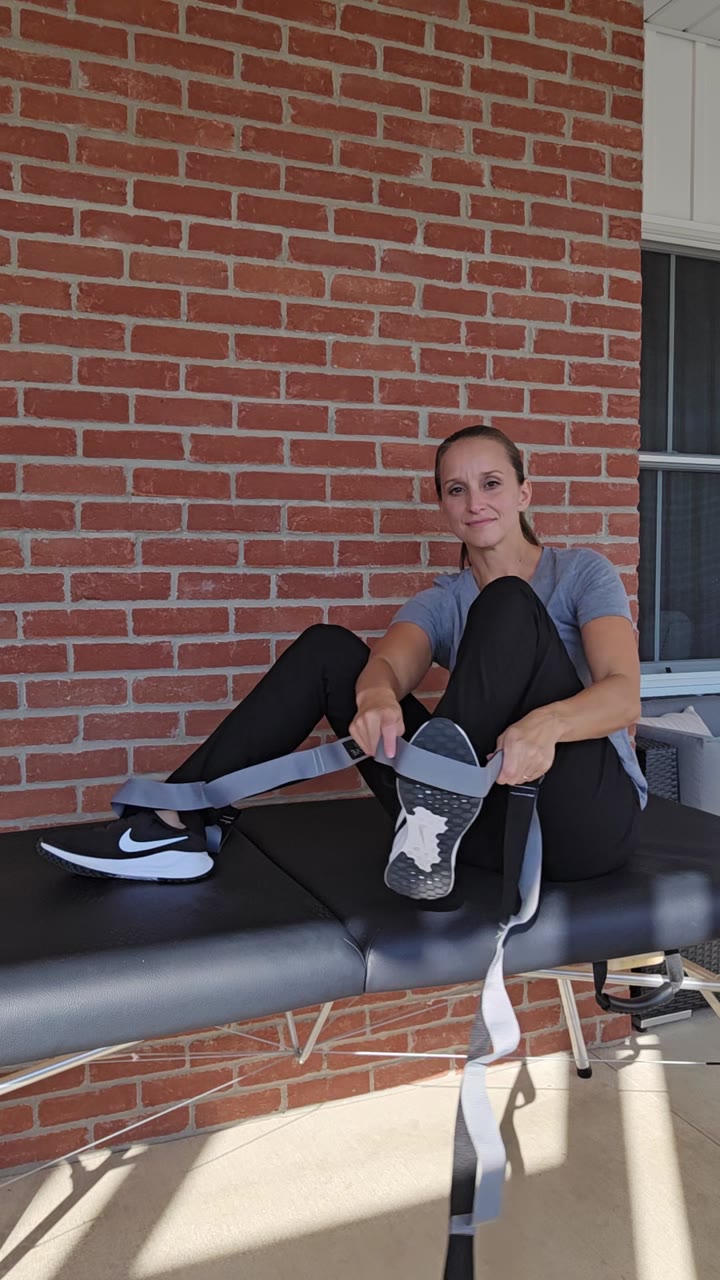
Heel slide demonstration: lying on back, slow controlled range
Prone knee flexion: lying face down and bending your knee toward your glute — uses gravity differently and often gets range that heel slides don't. It's also a nice way to assess whether your quad tightness is part of what's limiting you, because you'll feel it there.
 Skiv © 2026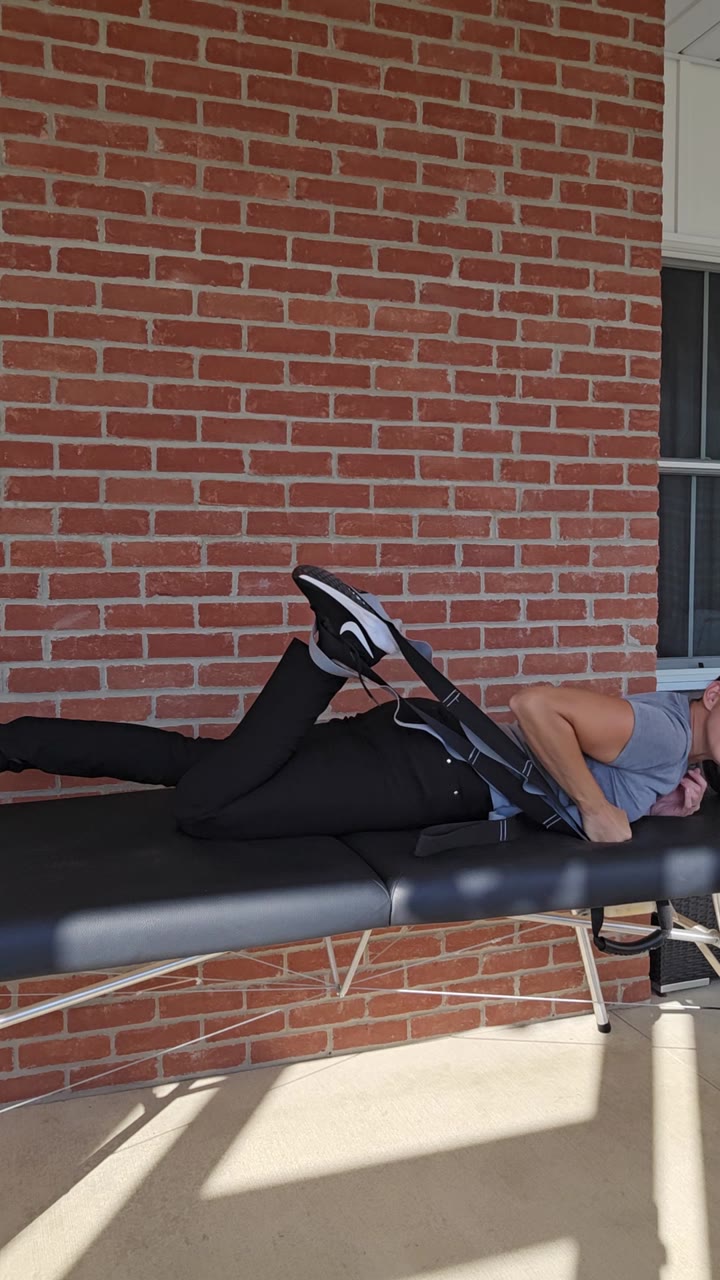
Prone knee flexion: face down, bending knee toward glute, gentle range
What I've seen happen over and over in my practice: someone comes in convinced they'll never kneel again, and within a few weeks of consistent range of motion work — before we've even touched strengthening — they can bend their knee noticeably further. Not because we did anything dramatic. Because we were consistent and patient and gave the tissue what it needed.
Range of motion work isn't glamorous. It doesn't feel like a workout. But it is often the thing that unlocks everything else.
What building that capacity looks like
The ability to kneel and get back up comfortably comes from a combination of knee flexion range, quad and glute strength, and balance. All of these can be improved with the right approach.
You don’t start by trying to kneel and push through pain. You start by building the foundational strength in standing positions, squats to a comfortable range, step-ups, single-leg balance work and gradually increasing the demand.
If you want to start with squat variations that are actually designed for knees that aren’t ready for full depth, I broke down the seven best options in a separate article. The box squat and the wall squat are where most people should begin.
7 Best Squat Variations for Knee Pain
Progressive loading means starting where you are, not where you want to be. The body rebuilds in order, and the order matters.
The knee replacement conversation
I want to be honest with you about something, because I think it's important and I don't see it said enough.
If you've been told you might eventually need a knee replacement or if you're at the point where a surgeon has mentioned it as a future possibility, kneeling is one of the first things you should know about. Because after a knee replacement, most people cannot kneel comfortably. Sometimes ever.
It's not a complication. It's a function of the prosthetic design. The artificial joint doesn't have the same tolerance for deep flexion that a natural knee does. Many people after knee replacement surgery find that kneeling on a hard surface is uncomfortable or impossible, that gardening on their knees is no longer accessible, that getting on the floor with grandchildren takes a completely different strategy.
I'm not saying this to frighten you. I'm saying it because I think people deserve to make decisions about their knee care with the full picture in front of them.
Can you kneel after a knee replacement?
Some people can, with modifications like on a soft surface, limited time, one knee at a time. Many cannot, or find it significantly more difficult than before. The research on this is consistent: kneeling is one of the activities most commonly reported as limited after total knee replacement, alongside squatting and deep flexion activities.
This is one of the reasons I'm genuinely passionate about conservative care, about building the strength, range, and movement quality that lets your knee function well for as long as possible, so that surgery becomes a last resort rather than the only conclusion. Not because surgery is always avoidable. Sometimes it's absolutely the right call, and I have enormous respect for the surgeons doing that work.
But if you are in the phase where your knee is painful and limited, where kneeling is already becoming a calculation, that is exactly the window where the right movement work can make the most difference. The knee is telling you something. And there is a lot of room to change the trajectory before that window closes.
Who this matters to most
If you are in your 40s or 50s and kneeling has gotten harder, you are in the most important phase. Your muscles are still responsive to training. Your joint still has the capacity to improve. The changes you make now compound over time.
If you're someone who has been told to "just wait until it's bad enough" for surgery then I want you to know that waiting is not neutral. The strength you lose while you wait is real. The movement patterns your body builds around the pain are real. The longer a knee operates in a limited, compensated state, the more work it takes to reclaim function.
That doesn't mean surgery is avoidable for everyone. But it means the work you do before and instead of surgery matters enormously and most people haven't been given a clear plan for what that work actually looks like.
The goal is the version of yourself at 70 or 80 who gets on the floor to play with grandkids, stands back up with confidence, and doesn't have to calculate whether the object on the floor is worth retrieving.
That version of you is built by the decisions you make right now.
Where to start
Want a clear, progressive path for building the strength your knee needs for real life? That's exactly what I cover in 3 Steps Forward. One email a week. No fluff.
Curious where your balance and squat strength actually are right now? The Knee Function Self-Test includes both and it’s free.