Knee Pain When You've Been Sitting Too Long (Why Just Get Up and Move Is Bad Advice)
Your knee stiffens up after sitting for 30 minutes? A DPT explains why prolonged sitting triggers knee pain and what’s actually going on inside the joint.
You know the feeling.
You’ve been sitting in a meeting. Or at your desk. Or on the couch watching something. And when you go to stand up, your knee feels like it belongs to someone 30 years older than you.
Stiff. Achy. Like it needs a minute to remember how to work.
You do the little shuffle. The slow straighten. The “I’m fine, just give me a second” face. And after a few steps, it loosens up. Until next time.
If this is you, two things: you’re not imagining it, and you’re not falling apart. There’s a real reason this happens and once you understand it, the whole picture starts to make more sense.
Why sitting makes your knee stiff
When you sit for a prolonged period, especially with your knee bent, a few things happen inside the joint. And I know “inside the joint” sounds clinical, but stay with me this is actually kind of fascinating when you see what’s going on:
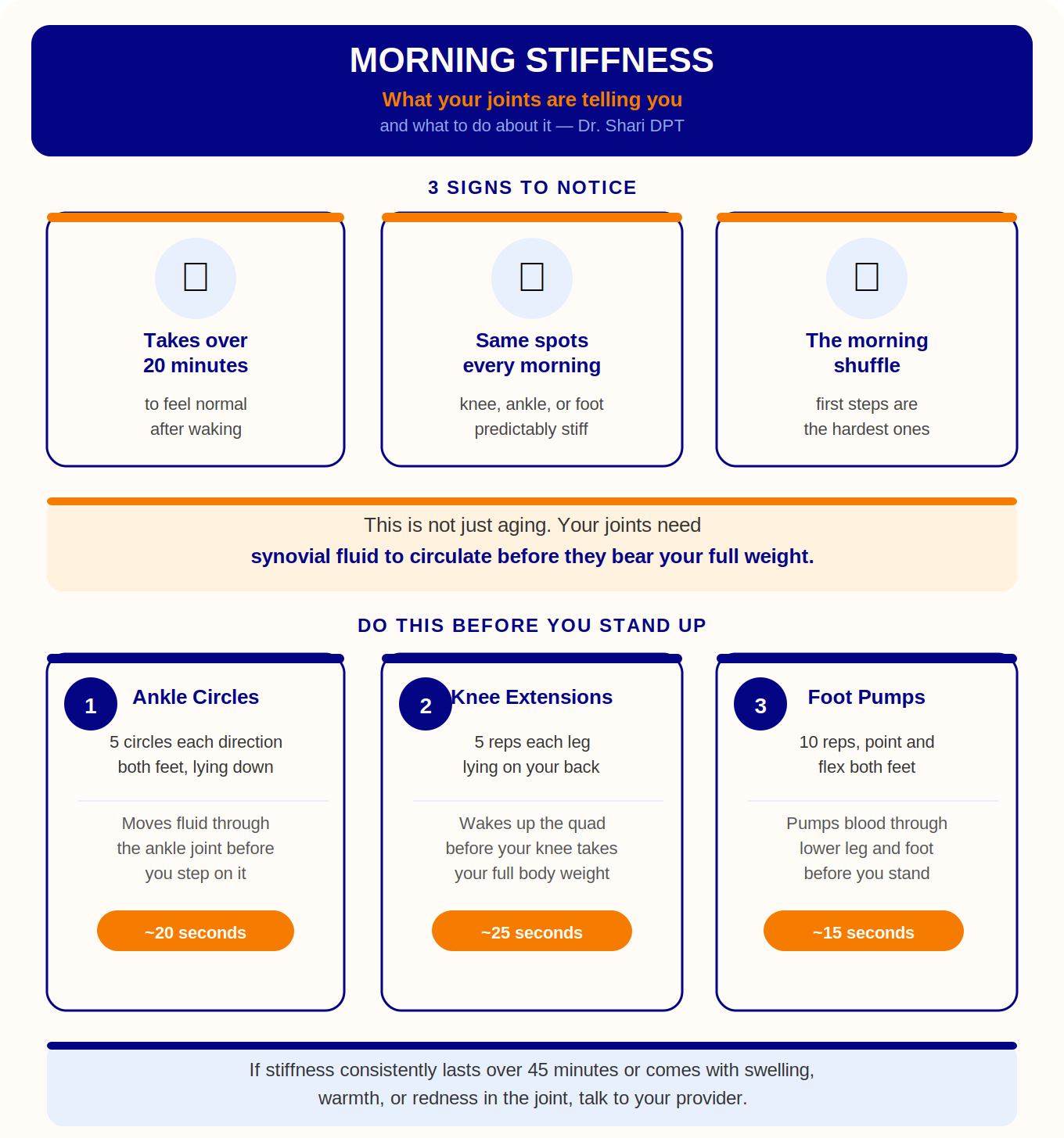
Synovial fluid settles. Your knee joint has fluid inside it that acts as a lubricant. When you’re moving, that fluid circulates and keeps everything gliding smoothly. When you’re still, it settles. I always tell people to think of it like a jar of salad dressing it separates when it sits, and you have to shake it up to get it working again. Movement is the shaking.
Muscles shorten in the bent position. Your hamstrings and calf muscles adapt to the position they’re held in. After 30+ minutes bent, they resist being asked to straighten quickly. It’s not that they’re “tight” in the way most people think they’re just settled into position.
The “warm-up effect” is real
Notice how it feels better after a few steps? That’s not your imagination. Movement circulates the synovial fluid, gently stretches the muscles back to their working length, and gets the knee moving again.
This is actually good news. It tells us the joint isn’t damaged in a way that prevents it from working it just needs consistent input to stay mobile.
Quick aside: this is also why the spring walking plan I put together works so well for people dealing with stiffness. Walking is the simplest way to keep that synovial fluid circulating and those muscles from locking up.
How to Start a Spring Walking Plan with Chronic Knee Pain
What “just get up and move” misses
You’ve probably heard this advice a hundred times. And it’s not wrong, exactly. But it’s incomplete.
Getting up and moving helps in the moment. But if you’re dealing with this every single time you sit for more than 20 minutes, the issue isn’t that you’re sitting too much. It’s that the muscles and structures around your knee don’t have the capacity to handle the demands of your day.
Telling someone with knee pain to “just move more” is like telling someone who’s drowning to “just swim.” The intent is right. The specificity is missing.
What actually helps is building the strength and mobility in the muscles around the knee so that sitting doesn’t create a shutdown. Quad strength, hip mobility, and kneecap tracking all play a role and they all respond to the right kind of targeted work.
If you’re curious about how your knee moves when you sit or stand up specifically I go into detail in my article on knee biomechanics and why your knee might be caving inward when you squat. Same mechanism, different context.
Why Your Knee Tracks Inward When You Squat
The movie theater problem
I call this one the “movie theater problem” because it comes up so often. You’re excited about a movie, dinner, a long flight, a road trip, anything that involves sitting for more than an hour. And the whole time you’re thinking about your knee. Choosing the aisle seat so you can stretch. Getting up during the previews to walk around. Planning your bathroom breaks around your knee, not your bladder.
That’s not how you should have to live. And you don’t have to but it does take the right kind of work to change it.
Things to pay attention to
Start noticing: How long can you sit before the stiffness kicks in? Is it getting shorter over time, or has it always been about the same? How many steps does it take before you feel normal again?
Those details matter. They’re data points. The same kind of data I look at when I’m building a plan for someone. They tell you where your knee is right now and how it’s responding to what you’re doing or not doing.
If you want actual numbers on where your knee stands, the Knee Function Self-Test I built gives you a baseline score across six real-world movements. It takes about 10 minutes, and it includes the sit-to-stand test that directly relates to this problem.
I dig into the “why behind the stiffness” and what to do about it in 3 Steps Forward, my free weekly newsletter. Short, specific, built for people who are tired of vague advice.